
Beirut and Lebanon’s debt, a short history

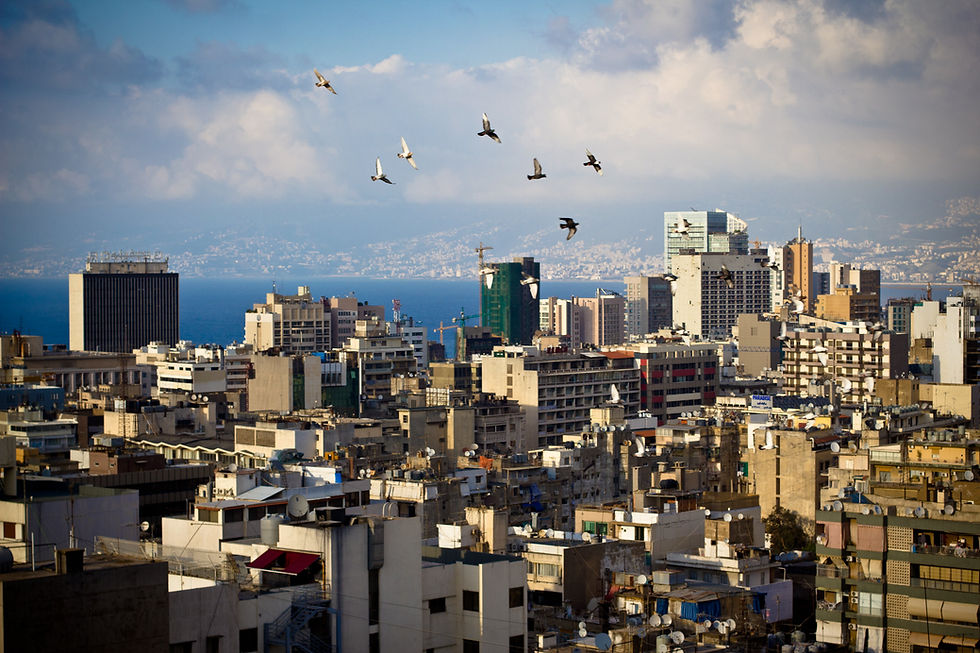
Before Israel’s ground invasion and air strikes, Lebanon was already in a debt crisis so deep that it shook the foundation of the country’s economic and political systems. At the roots of this debt crisis, France’s influence, oil cash from the Gulf and a corrupted alliance between bankers and politicians.
Written with the help of Corrine Jabbour for the online Degrowth Master at the Autonomous University of Barcelona
From 1989 to 2005
We start our story of Beirut at the end of the civil war, which ravaged Lebanon from 1975 to 1990, a war among Lebanese who ended with Syria and Israel as winners. We start where school history books in Lebanon stop because decades later, still no one can agree on the narrative. The Taif Agreement, signed in Saudi Arabia in 1989, turned the sectarian militias into political parties and split executive power between rival factions. Inside the city, the main physical division was the Green Line, a no man’s land, where snipers ruled and plants were allowed to grow freely, between West Beirut, controlled by predominantly Muslim militias (Lebanese National Movement, a Palestinian PLO, Arab Nationalists, leftists, and Muslim coalition), and the Christian militias territory, East Beirut.
Beirut was scarred by the years of war. The financial district, once the banking center of the Middle East, was in ruins. Hundreds of thousands had died during the war, but many more emigrated to seek a peaceful life. About two thirds of the entire Lebanese population now live outside the country, especially among the educated middle-class.
In the Southern outskirts of the city, the coastal plain turned into concrete under the influx of Shia population fleeing the Israeli occupation in the South of Lebanon, with Palestinian refugee camps settling in a permanent state of temporariness. Barred from working or owning property, the Palestinians relied on the informal economy and United Nations aid through the UNRWA. Towards the mountains of the East, the Christian middle class was fleeing from the fighting in the center and building upon the flanks.
For everyone living in the periphery, the rule was the same: survival. In the absence of functioning public services, electricity was obtained by tapping high voltage lines with wires. Water was obtained in a similar way, or dug out of precarious wells. Food and shelter were controlled and distributed along sectarian lines. The Shia Hezbollah had its own housing and education system. The Sunni and Christian had their own clientele networks with closer ties to the central government.
The 1992 election gave Lebanon its first government after the civil war. Emerging on top of the political strife, Rafic Hariri became prime minister. Hariri, a real estate businessman, was considered an architect of the Taif agreement and had close ties with both the Saudi royal family and the Assad regime in Syria. With the support of the World Bank, Hariri launched a vast program of post-war rebuilding funded by external borrowing in Eurobonds.
The plan was to make Lebanon the “Singapore of the East”, counting on fast economic growth to pay off the loans, fueled by infrastructure investment and cash influx into the reborn Lebanese banking sector. But the optimism of the Oslo Accords, settled in 1995 between Israel and the Palestine Liberation Organization, did not last. Instead of the “peace dividend” that Lebanon was hoping for, continued conflict between Hezbollah and Israel at the southern border caused civilians to leave their homes and increased the housing pressure in Beirut's suburbs.
In a context of sectarian rivalry and dysfunctional public services due to adversarial provisioning of the population’s basic needs, Hariri’s plans for Lebanon’s debt-fueled growth quickly became a self-enriching scheme benefitting his own wealth and that of his allies. The largest part of the infrastructure budget was spent in bribes to clients, and the electric grid was so plagued by corruption and unpaid bills that the state company eventually collapsed. But Hariri was a real estate mogul, so his effort to rebuild the center of Beirut was personal.
By 1991, before being nominated prime minister, Hariri was the architect of the Solidere Law, which commanded the creation of a one of a kind private company with regal powers over the reconstruction of the devastated city center. The creation of Solidere changed the original owners of the destroyed homes into minority shareholders of Solidere. Many were expelled under pretext of safety hazard, as Solidere expeled the least fortunate home owners and replaced the traditional souks by glassed luxury stores.
Most of the city center is now unaffordable for common people and private security guards dispatch informal street vendors so the customers of luxury stores are not interrupted in their shopping. The new homeowners of the Beirut Central District don’t really live there. They are the top 1% of households in the Gulf and they only bought these homes as safe deposits, investments to hold value in case oil prices went down or the stock market crashed. The rocky seafront where Beirut inhabitants used to fish or gather in the evening, sitting around or idly walking by, has been partly privatised. Private interests reclaimed land from the sea with rubble and concrete and declared it property. Glittering yachts live there, in a private marina. You can walk by, but guards might stop you if you try sitting around without a cocktail, or if you don’t follow the dresscode.
When Hariri became prime minister in 1992, he also became the effective leader of the Council for Reconstruction and Development, the government body overseeing Solidere, a blatant conflict of interest that put him in position to overcome any opposition from the original inhabitants.
By 2001, the reconstruction of downtown Beirut was well under way. High fashion stores and cafés connected to the world with high speed internet helped the city rival European capitals. Archeological discoveries were made during the works, extending budgets and deadlines while providing pleasant Roman ruins to the tourists. Outside the center, in the suburbs and in the rest of the country, people were still coping with intermittent power outages and unreliable public service due to corruption and clientelism.
As Hariri’s wealth grew all the way to the Fortune 500 list thanks to his personal interest in the reconstruction effort, Lebanon’s debt grew so much as to reach a debt-to-GDP ratio of 170% in 2002. Beirut’s private banks, despite an influx of foreign deposits thanks to bank secrecy and high interest rates, did not contribute to the public budget. Lebanon was spending up to 80% of its public budget on debt payments, for a large part paid to its own private banks.
Before the IMF and the World Bank could come down on the country to impose austerity regimes, Hariri called his old friend Jaques Chirac, the French President. Under the Paris I and II agreements, Lebanon obtained what amounts to a credit extension and some leniency from the Bretton Woods institutions. Hariri promised new consumption taxes and the privatisation of public services to please the IMF. Twice already since 1992, the IMF, the World Bank and France specifically, had supported Hariri as he put Lebanon into debt while enriching himself.
As Hadi Makarem puts it, the liberal recipe for debt-fueled growth was doomed to fail in Lebanon after the civil war, because the state was too weak to maintain the rule of Law, and the militias turned into political factions were too keen to maintain their respective influence instead of the common good. It seems, however, that Hariri was the leader that the Bretton Woods institutions and France had chosen for Lebanon.
On the 14th of February 2005, prime minister Rafic Hariri was killed in an explosion where 21 people lost their lives, including his bodyguards and Bassel Fleihan, minister of economy and trade. Upon the threat of a resurgence of political violence, the people of Lebanon rose peacefully in mass demonstrations to call for democratic elections and the end of the interference of the Syrian government in the politics of their country. This upheaval became known as the Cedar Revolution.
From 2005 to 2019
Despite the fears of a descent into chaos, Hariri’s assassination did not cause the crumbling down of the system he had created. Riad Salameh, governor of the Lebanese central bank (Banque du Liban) and close ally of Hariri, remained at the helm and made sure to pursue his legacy of personal enrichment at the expense of the people of Lebanon. Salameh was later condemned for multiple counts of corruption and embezzlement. From 2005 onwards, the system works.
To understand what Salameh was really doing at the Banque du Liban, we need to go back to 1997, and the decision to “peg” the lira to the dollar. The goal was to end the deflationary spiral of the national currency after the civil war by anchoring it to the rate of the dollar, thus providing financial stability to the new peace, and confidence in foreign investors.
This illusion of permanence had a price. The central bank had to maintain a dollar reserve to be able to buy and sell liras to “defend” the peg according to the fluctuation of the money supply. But this only works if a steady inflow of dollars feeds into the state’s treasury, as in the case of oil money in Saudi Arabia or Dubai. Lebanon did not have oil. Instead of oil, Hariri and Salameh used the money borrowed in eurobonds to finance the reconstruction, and private bank deposits in dollars coming from the Lebanese diaspora.
The country’s private banks, receiving foreign deposits in dollars, were invited to place these deposits at the central bank at a good rate. Lebanese banks attracted foreign deposits with high interest rates and a no questions asked approach to bank secrecy, allowing for money laundering of all kinds. The lira was thus maintained artifically high and the dollars kept flying in as long as Hariri was able to sell luxury real estate to the Gulf’s wealthiest, and private banks attracted their petrodollars with high interest rates.
This aberrant system entirely based on debt and high interest rates prevented the local economy from developing meaningful productive activity. It was easier for investors to capture the rent of high interest rates than to lend to local companies. Global creditors such as the World Bank, the IMF and the Paris Club frequently bailed out Hariri from near default because he was selling them the dream of a service based economy pulled by a creative financial sector and tourism.
In the 90’s zeitgeist of liberal hegemony led by the almighty dollar, Lebanon was a beacon of modernity in the Middle-East. In 2011, when the civil war broke out in Syria, Lebanon’s economy was a mere house of cards. The wealthy tourists left downtown with their money, replaced by a massive influx of refugees escaping Syria, looking for housing and jobs, while war was creeping in, with bomb attacks targeting Hezbollah for siding with the Assad regime. Militia check points showed up again, and mistrust between neighbours.
The Banque du Liban and the private banks at this point formed a well oiled machine. Guided by the same purpose of maintaining or growing their wealth, they accelerated the system into a ponzi scheme. The central bank would borrow dollars from private banks at high interest rates, to pay the yields of eurobonds that private banks were buying in return. This dollar mill was using private deposits and saving accounts to borrow on international markets and fund a network of corrupted financiers and politicians.
In Beirut in 2015, the state wasn’t paying for trash collection anymore. The Naameh landfill, opened in 1997, the same year as the start of the dollar peg, eventually closed after receiving about seven times the amount of waste it was destined to receive. Come summer, piles of trash were left abandoned in the streets, on the side of the roads, in parks and rivers, all the way to the fish in the sea. Power cuts made air conditioning unreliable, forcing inhabitants to leave their windows open to the rancid stench of organic fermentation. Water outages obliged them to rely on private wells contaminated by garbage fluids. People eventually had to burn the trash themselves and poison the air with polymer smoke.
Starting on social media, the “You Stink!” movement started as a mental health valve to use humour and art to demand the restoration of trash collection services. Then, gathering in parks and public spaces, it became a decentralised, non-sectarian movement claiming regime change and the collective provision of basic needs, such as public health. Beirut Madinati, “Beirut My City” is one of the civic initiatives born out of this crisis, as a collective emergency response.
From 2015 to 2025
By 2019, the country’s finances take a bleak turn. The GDP is sinking and the debt-to-GDP ratio is at its highest since 2008. By July, credit rating agencies downgrade the country and private banks, anticipating a bank run, start to restrict dollar withdrawals. In September, gas stations go on strike because they can’t access their own dollars to import oil.
On the 17th of October, not knowing that the date would give its name to the ensuing revolution, president Michel Aoun and prime minister Saad Hariri try to please creditors and propose a sharp increase of taxes on consumption, and singularly a tax on messaging applications, which will be known as the WhatsApp tax. The same day, protesters take to the street to protest against the new taxes and claim the end of the corrupt sectarian rule.
Banks immediately closed their doors to prevent a bank run. On October 29, president Saad Hariri resigns and banks re-open, but with strict informal capital restrictions. Only a few hundred dollars per week are allowed for withdrawal. Account holders start robbing banks to withdraw their own money, sometimes with toy guns, sometimes with real ones. Meanwhile, the government and banks are in a deadlock. Private banks demand that the Eurobonds be paid, while the government has run out of dollars. The snake finally bit its tail.
In 2020, even the IMF is calling for an end of bank secrecy laws and for accountability of the elite. Protests continue until March, when the covid lockdown finally clears the street and puts a hard stop to tourism, and to the world’s economy. Lebanon officially defaults on its sovereign debt.
The Beirut port explosion on August 4 puts an end to the mass protests against the government. Instead. The people of Beirut organise and survive, clearing the rubble, sharing food and shelter with survivors. The focus of political activism moves to holding the powerful accountable, while the investigation is stalled and delayed.
Since then, most public services are maintained by informal networks, with the help of NGOs that often try to bypass the government.
The most recent development of this financial tragedy is the Gap Law of 2025, the first official recognition of the abysmal hole in the accounts of both the state and the private banking sector. As bankers and politicians are shifting responsibilities side to side, a movement is building in the population around figures like Toufic Gaspard to claim justice. Not far, behind closed doors, the private creditors of the defaulted eurobonds organised in a club with asset managers like BlackRock and Amundi to exact as much profit as they can from the rubble.


Comments